


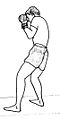
Upright Stance Semi-crouch Full-crouch
In a fully upright stance, the boxer stands with their legs shoulder-width apart and their rear foot a half-step in front of the lead foot. Right-handed or orthodox boxers lead with the left foot and fist (for most penetration power). Both feet are parallel, and the right heel is off the ground. The lead (left) fist is held vertically about six inches in front of the face at eye level. The rear (right) fist is held beside the chin and the elbow tucked against the ribcage to protect the body. The chin is tucked into the chest to avoid punches to the jaw which commonly cause knock-outs and is often kept slightly off-center. Wrists are slightly bent to avoid damage when punching and the elbows are kept tucked in to protect the ribcage. Some boxers fight from a crouch, leaning forward and keeping their feet closer together. The stance described is considered the "textbook" stance and fighters are encouraged to change it around once it's been mastered as a base. Case in point, many fast fighters have their hands down and have almost exaggerated footwork, while brawlers or bully fighters tend to slowly stalk their opponents. In order to retain their stance boxers take 'the first step in any direction with the foot already leading in that direction.'
Different stances allow for bodyweight to be differently positioned and emphasized; this may in turn alter how powerfully and explosively a type of punch can be delivered. For instance, a crouched stance allows for the bodyweight to be positioned further forward over the lead left leg. If a lead left hook is thrown from this position, it will produce a powerful springing action in the lead leg and produce a more explosive punch. This springing action could not be generated effectively, for this punch, if an upright stance was used or if the bodyweight was positioned predominately over the back leg. The preparatory positioning of the bodyweight over the bent lead leg is also known as an isometric preload.
Left-handed or southpaw fighters use a mirror image of the orthodox stance, which can create problems for orthodox fighters unaccustomed to receiving jabs, hooks, or crosses from the opposite side. The southpaw stance, conversely, is vulnerable to a straight right hand.
Source: Wiki
Comments
0 comments
Please sign in to leave a comment.